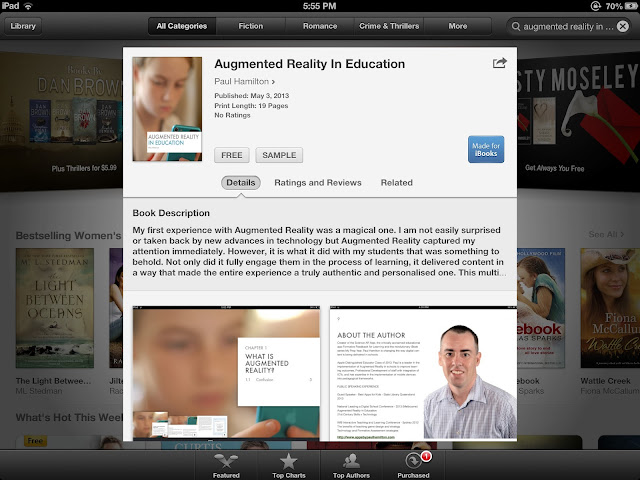
Augmented Reality in education looks at how AR is having an impact on schools around the world. Created by Paul Hamilton, leader in augmented reality in schools and education.
Download these educational worsheets (print images) and watch the magic. Students become engaged in the learning experiences like never before. These are just experiments and worksheet may not be full completed.
MORE info at:
http://www.appsbypaulhamilton.com/#!ar-experiments-aurasma/c23ku
Last night I was cooking dinner and watching my 7 year old struggle with her Mathematics homework.
It was related to weight and categorising objects from lightest to heaviest. It was the all too common problem for parents. When to step in? What have they covered in class? not to mention the bigger question of whether or not young students should have to do homework at all!!!
Anyway, back to the dilemma. It was then that I realised it would be so beneficial for the teacher to come home with my daughter so that both Isobel and I could ask questions.
In my role as Primary ICT Coordinator I am exposed to new technologies on a daily basis. My mind automatically looked at Augmented Reality as a solution to meet my daughters problem. So I started the process of putting together a worksheet that would allow a virtual teacher into my home, using Augmented Reality to put the process all together.
Whilst not perfect and still having to deal with the entire class personalisation, the result was amazing. My daughter was able to engage fully with the homework task, receiving instant feedback on each problem. The situation was also personalised, having already seen what my daughter was having problems with.
Watching her interact with the work sheet gave me an insight of where we can fully utilise Augmented Reality in Education. Our children learn differently than I did as a child and we need to explore such technologies and the potential they have for making a significant contribution to the way students learn.
Is this the future of Education? Year 2 students uses Augmented Reality blended with Virtual reality to complete her Mathematics homework.
The aspects that work here are:
Personalised learning
Instant feedback for student
Flipped Classroom
Engagement in learning process
Caters for all ability levels
It certainly ticks a few boxes. For those wondering how I did this? I used 3 educational apps for iPad. Explain everything to do the tutorials, tellagami to do the virtual avatar and Aurasma to put the Augmented Reality together.
To find out more about Augmented Reality in Education download my free iBook from the iBookstore at:
https://itunes.apple.com/au/book/augmented-reality-in-education/id641019829?ls=1
Why do we use technology in our classroom? Eye Candy? Because it's cool? Of course the answer is NO, but why do we keep making the same mistakes?
Let's take a look at Augmented Reality in Education as an example. The eye candy - irrelevant 3D models! Dinosaurs and crazy animated characters jumping of the screen. Big impact - Absolutely. Engaging? Absolutely! But engaged in what? The learning process? Maybe not.
Let's use Augmented Reality in classrooms to:
engage in the learning process
teach/explore key learning concepts
persuade the mind
Next time you use Aurasma or any other AR platform ask yourself "why am I doing this with my students?"
We know ICT integration should have reason and purpose. We have a responsibility to teach in a manner that reflects our philosophical beliefs.
https://itunes.apple.com/au/book/augmented-reality-in-education/id641019829?ls=1
Proud to announce Augmented Reality in Education featured on the iBookstore in the Made with iBooks Author category and the New Category.
Download below.
https://itunes.apple.com/au/book/augmented-reality-in-education/id641019829?mt=11
“Whilst technologies such as QR Codes and Hyperlinks provide a valuable service with holding data and directing individuals to external sites, Augmented Reality connects real life objects, places and people around us to a variety of information and simulated experiences. The power of students self exploring the physical world around them and discovering for themselves should never be underestimated.
Learning should be connected to life and the experiences our students have already been through and will go through. This will enable more authentic learning experiences for our students. The results outlined later in this book look at a Mathematics Augmented experience. Linking an effective video tutorial to that of a real life object resonates with students. As one of my students stated:
“Next time I look at any triangle in the world, I will remember how to work out the area”.
This comment reinforces the inadequacies of linking tools such as QR Codes and traditional Hyperlinks. By linking a structured lesson to that of a real life objects, the student automatically makes connection with other real life objects resulting in a conceptual learning approach. ”
Excerpt From: Hamilton, Paul. “Augmented Reality In Education.” v1.2. Paul Hamilton, 2013. iBooks.
This material may be protected by copyright.
Check out this book on the iBookstore: https://itunes.apple.com/WebObjects/MZStore.woa/wa/viewBook?id=641019829
Paul Hamilton has just published a free multi touch iBook on the use of Augmented Reality in Education. Outlining statistics, influences on the mind and practical tutorials for creating an AR experiences for students, this book is proving to be a valuable edition to your iBook library. And the best thing it is a FREE iBook.